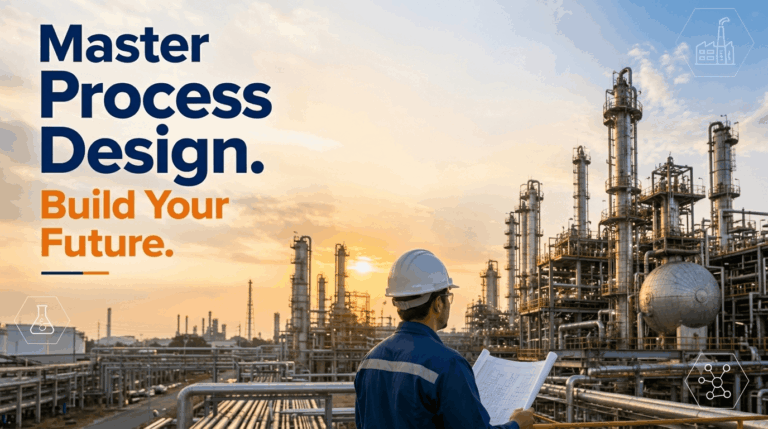
Process engineers apply their understanding of chemistry and physics to convert chemical ideas into functioning systems and equipment to design and construct chemical process facilities. Understanding a chemical plant design example is essential for chemical process plant design and commercial viability. Once chemical process engineers graduate and begin their professional careers, process design experience becomes very critical in converting theoretical knowledge into practical plant design.
This report outlines the major steps involved in designing a chemical process facility, including the types of engineering calculations, the process safety and engineering equipment considerations, and the types of engineering equipment employed in the successful design of a chemical process facility.
Understanding Chemical Plant Design
Let us consider a case where a chemical process facility has to produce 100 tons of a liquid industrial chemical in a continuous process. The process facility has to ensure it maintains the quality and quantity of the product, while at the same time controlling the operational costs, and protecting personnel and the environment.
The process design team estimates the required production capacity, specifies raw material requirements and product specifications, and determines the operating conditions of the process. Based on the raw material availability, engineers determine the best way to consume energy and determine the possible impact of the process on the environment. The process design team has to come up with various process alternatives. From a safety and reliability perspective, process design and the available alternatives become more critical in the chemical manufacturing regions of Gujarat, viz., Bharuch, Ankleshwar, Dahej, Vadodara.
- Process Flow Diagram Development
A PFD for the hypothetical plant may include raw material storage, feed preparation, a reactor, heat exchangers, separation equipment, and storage for the product.
Once the general layout of a process has been defined, engineers perform material and energy balance calculations to arrive at the flow rates, temperatures, pressures, and compositions of various process streams. These calculations help to establish the design basis for the type and size of process equipment as well as utility requirements.
- Equipment Sizing and Selection
The next step in the process design is to define the details of the equipment. The design of reactors depends on many factors including capacity, kinetics of the reaction, the required residence time, heat transfer, and pressure. Other factors to be considered in the design of process equipment and systems include pump capacity, flow and differential pressure, and properties of the fluid being pumped.
Heat exchangers are designed to transfer process heat to or from a process stream while maintaining the temperature of the process stream within design limits. This process design project example illustrates the importance of process design calculations and the interaction of various process design disciplines to make equipment and process system selections.
- Process Safety and Risk Assessment
Safety is the first consideration in the design of a chemical process plant. Potentially flammable and/or toxic materials, high pressures and temperatures must be evaluated.
A Hazard and Operability study (HAZOP) is a systematic way of identifying potential deviations in a process and evaluating their effect on safety. This may lead the design team to incorporate additional protection equipment in the process. Other safety design considerations may include emergency shutdown systems, process monitoring and control systems, and proper containment of toxic and/or flammable process materials.
Throughout design, engineers must consider the requirements of applicable regulations as well as recognized engineering standards.
- Utility Planning and Energy Optimization
Industrial plants utilize various utilities including cooling water, steam, power, compressed air, and nitrogen. Demand for each utility is a function of design and operational conditions.
Heat integration, efficient equipment selection, insulation and heat recovery help reduce energy consumption and operating costs.
Benefits of these improvements include more sustainable plant operations and more favorable economic impacts.
What This Case Study Teaches Aspiring Engineers
An analysis of an industrial process case study demonstrates that design of a process requires integration of process calculations, equipment specifications, safety and economics.
When searching process engineering courses online, prospective students should look for materials that cover the following: analysis and integration of material and energy balances, equipment sizing, process safety, P&IDs and PFDs, and standard engineering practice and documentation.
Participating in case studies and hands-on assignments can help users understand the process engineer’s perspective on manufacturing industry challenges. Knowledge in this area can help the chemical engineering graduates of Gujarat to make inroads into chemical manufacturing, oil & gas, petrochemicals and related process consulting sectors.
Conclusion
Plant process design is a combination of technical calculations, engineering judgment and a balance of economic interests and management of plant safety. Often times, design decisions impact the performance of the plant as a whole. An example of a structured plant design gives potential engineers an opportunity to examine how various design alternatives may impact the overall performance of the plant.
Energy Learning offers process design training in Vadodara and online process design training. This training can help develop the practical process design skills of participants in various fields of engineering and prepare them for practicing process consulting as well as manufacturing industry in Gujarat and beyond.